
Time Clocks vs. Tablets: Understanding the True Cost of Workforce Data Collection

As workforce management becomes more connected, compliance-driven, and data-dependent, organizations need more than a basic way for employees to punch in and out. They need a reliable workforce data collection strategy that supports payroll accuracy, labor visibility, compliance, employee accountability, and long-term operational efficiency.

Every punch matters.

When time data is inaccurate, delayed, or collected through an unreliable device, the impact can flow directly into payroll errors, administrative rework, scheduling issues, compliance exposure, and unnecessary labor cost.
That is why the device used to collect workforce data matters. While tablets may appear less expensive at first, the full cost of a tablet-based time collection solution often looks very different once organizations include mounting enclosures, mounting brackets, external readers, power accessories, battery management, replacement cycles, IT support, security controls, and lifecycle maintenance.
Purpose-built time clocks are engineered specifically for workforce management. They are designed to deliver dependable operation, secure authentication, flexible deployment options, faster ROI, and lower operating cost across a wide range of workforce environments.

Tablets Can Work, but They Are Not Always the Best Long-Term Investment

Modern workforce management strategies can include multiple punch collection methods, including purpose-built time clocks, kiosk or tablet-based punching, web punching, mobile punching, and telephone punching. These options give organizations flexibility for remote employees, office teams, field workers, temporary locations, and exception-based scenarios.

However, flexibility should not be confused with the best long-term primary device strategy. Tablets are general-purpose devices. They can require operating system updates, mobile device management, security controls, app restrictions, mounting hardware, protective enclosures, power planning, battery monitoring, and more frequent replacement.
In many cases, what begins as a lower upfront device cost becomes a higher total cost of ownership when the complete solution is considered.

The Hidden Cost of Tablet-Based Time Collection

A tablet-based solution may include more than the tablet itself. Organizations often need to factor in:

  • Tablet hardware and replacement units
  • Mounting enclosures and mounting brackets
  • External card, QR, or biometric readers where needed
  • Power adapters, charging strategy, battery health, and cable management
  • Protective cases or security housings
  • Mobile device management, app control, and customer IT support
  • Operating system updates, compatibility risks, and device refresh cycles
  • Downtime, troubleshooting, theft, damage, and user misuse
Once these costs are included, the tablet is no longer just a tablet. It becomes a collection of hardware, accessories, policies, support requirements, and lifecycle expenses. That is where purpose-built time clocks often deliver a stronger financial case.

Why Purpose-Built Time Clocks Deliver Better ROI

Purpose-built time clocks are designed for workforce data collection from the start. Instead of adapting a general-purpose device into a time collection terminal, organizations can deploy hardware built for secure employee authentication, consistent operation, simplified management, and long-term use.

The Ultima Series provides multiple time clock options for different workforce environments. With support for flexible authentication methods, durable hardware, connectivity options, and secure workforce data collection, these devices help organizations reduce support burden, improve reliability, and protect the accuracy of time and labor data at the source.
This value becomes even stronger when a solution includes long-term warranty protection, which helps protect the customer’s investment, reduce replacement concerns, and improve long-term ROI. For many organizations, the better business decision is not the lowest initial device price; it is the solution that delivers the lowest operating cost over time.

Tablet/Kiosk, Web, Mobile, and Telephone Punch Still Have a Role

The goal is not to say tablets or other punch methods have no place. They do. Kiosk/tablet, web, mobile, and telephone punch options can be valuable when organizations need flexibility for remote employees, mobile teams, office workers, temporary locations, or backup scenarios.

The key is choosing the right punch method for the right use case.

Quick Comparison: Tablet-Based Collection vs. Purpose-Built Time Clocks
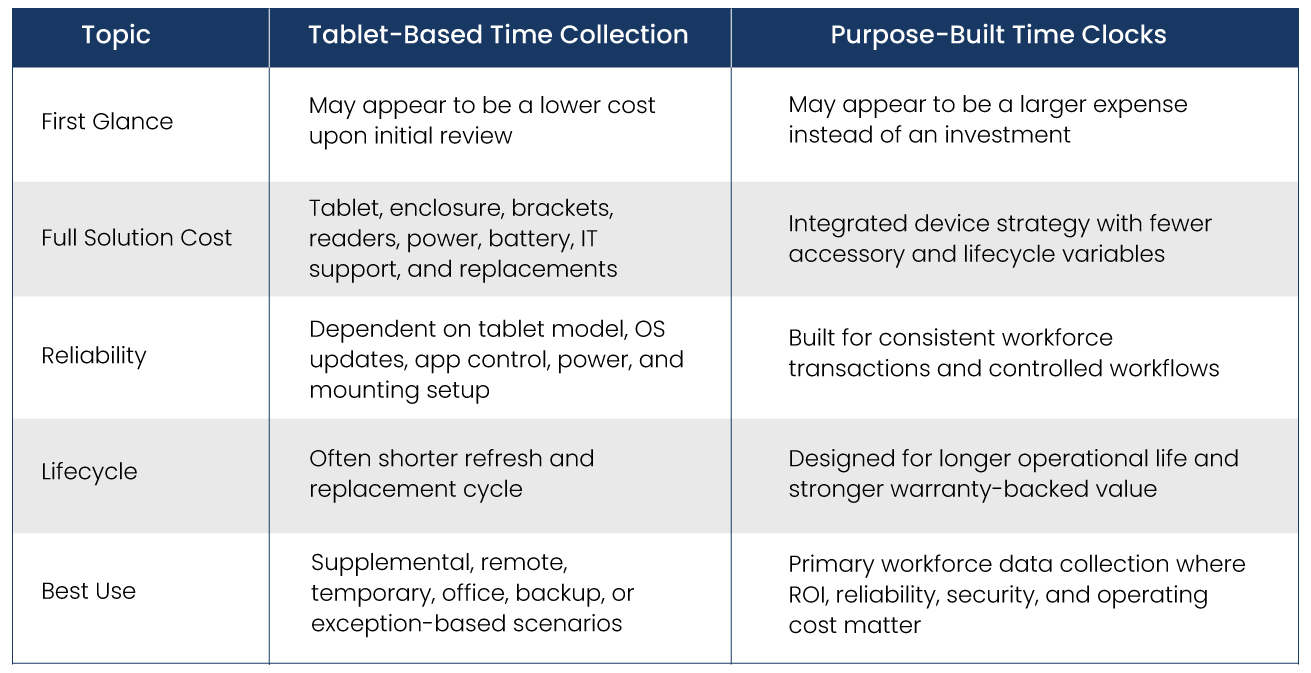
For organizations evaluating a primary, long-term workforce data collection strategy, purpose-built time clocks should be strongly considered because they are designed for reliability, security, lifecycle value, and lower operating cost.

The Bottom Line

Purpose-built workforce management devices help organizations collect accurate time and labor data, improve payroll accuracy, strengthen accountability, reduce administrative burden, and lower long-term operating cost.

Tablet, kiosk, web, mobile, and telephone punch options are important parts of a complete workforce data collection strategy. But when organizations evaluate the full cost of tablet-based time collection—including hardware, mounting, readers, power, battery, support, replacement, and lifecycle expenses—purpose-built time clocks often deliver faster ROI, lower operating cost, and stronger long-term value.

With multiple device options and the confidence of ZKTeco WFM’s warranties and customer support, organizations can choose workforce data collection technology built not just for today’s punch, but for years of reliable operation. Explore how purpose-built time clocks can help improve workforce data accuracy, reduce operational risk, and support stronger long-term ROI.